
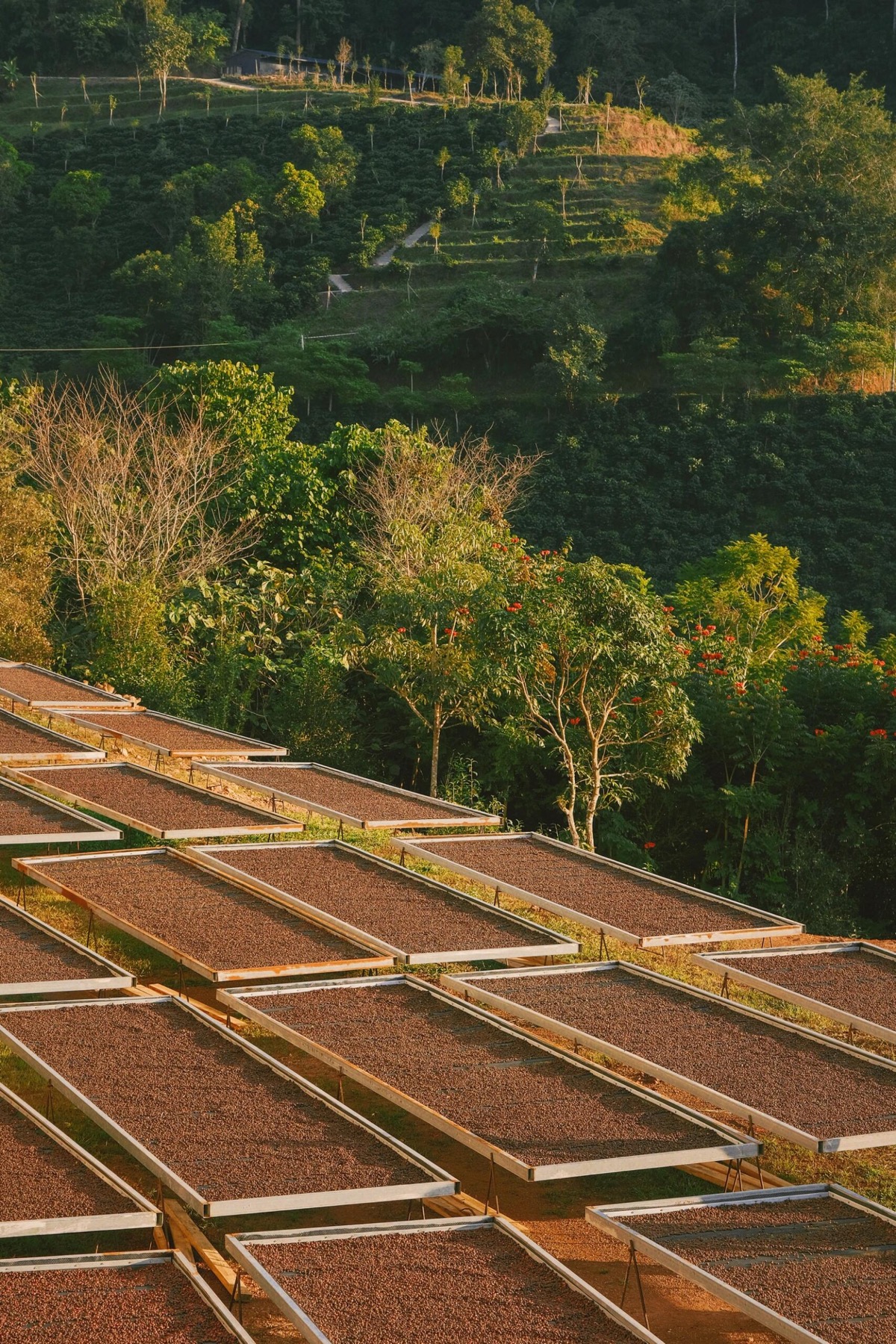
For many international coffee buyers, Yunnan is still a relatively unfamiliar origin. The province is better known globally for tea, mountains, and biodiversity than for coffee, yet it has quietly become the center of China’s Arabica production.
To understand Yunnan coffee, it is useful to look beyond the origin name itself: where it is grown, how it is processed, which varieties dominate the region, what the cup profile usually offers, and why its role in the coffee market is changing.
Quick facts about Yunnan coffee
| Region | Southwest China |
|---|---|
| Main producing areas | Pu’er, Baoshan, Dehong, Lincang, and Xishuangbanna |
| Main species | Arabica |
| Common variety | Catimor |
| Common processing | Mainly washed processing, with natural, honey, and experimental lots increasing |
| Typical cup direction | Balanced, mild acidity, medium body, nutty, caramel, brown sugar, cocoa, and milk chocolate notes |
| Market position | China’s core coffee-producing region |
A mountain coffee region in southwest China
Yunnan sits in southwest China, close to Southeast Asia and the regional coffee-growing belt. Its coffee areas are shaped by mountains, plateaus, river valleys, and subtropical climates. USDA reporting describes China’s coffee production as almost entirely Arabica from Yunnan, with many coffee areas located around 1,000 to 2,000 meters above sea level.
The major producing areas usually include Pu’er, Baoshan, Dehong, Lincang, and Xishuangbanna. For buyers, this matters because “Yunnan coffee” should not be treated as one single profile. Region, grade, processing method, and farm-level quality control all affect the final product direction.
The center of China’s coffee production
Official Chinese government reporting states that Yunnan produced around 146,000 tonnes of raw coffee beans in 2023 from approximately 80,000 hectares of coffee cultivation area, contributing about 98% of China’s total coffee production.
Yunnan is also becoming more visible in international trade. In 2024, the province exported 32,500 tonnes of coffee, a year-on-year increase of 358%, to 29 countries and regions. These figures do not make Yunnan a classic global origin like Brazil, Colombia, Ethiopia, or Indonesia, but they do show a clear transition from a mostly domestic or regional supply base toward broader international visibility.
Catimor, washed processing, and the real cup profile
A serious discussion of Yunnan coffee should start with Catimor. USDA reporting notes that Catimor is the most common variety in Yunnan because of its disease resistance, while also noting that some producers are exploring varieties such as Bourbon and Typica in response to demand for higher-quality coffee.
Yunnan should therefore not be described as a naturally elite specialty origin by default. Its historical strength has been practical: adaptability, productivity, disease resistance, and stable commercial Arabica supply. Its current opportunity comes from improving that base through better cultivation, processing, sorting, and variety selection.
Processing is another key part of the identity. Sucafina’s China origin notes describe Yunnan coffee as strongly associated with fully washed processing, with natural, honey, and semi-washed coffees representing a smaller but growing direction.
Washed Yunnan Arabica is often not about extreme fruit intensity or highly floral complexity. Its more typical value is a clean, balanced, approachable cup: mild acidity, medium body, sweetness, nutty tones, caramel, cocoa, brown sugar, and milk chocolate notes.
From commercial Arabica to quality improvement
For a long time, Yunnan was often understood as a commercial Arabica origin. That background should not be hidden, because it makes the current change more meaningful. The region is moving from a volume-led story toward a more quality-focused story, while still containing both commercial Arabica and selected higher-quality lots.
Alliance for Coffee Excellence’s Gems of Yunnan program shows this transition through a wider range of varieties and processes, including Batian, Geisha, Catimor, Yunka selections, washed, honey, natural, and anaerobic washed lots. The strongest examples show that Yunnan’s definition is still being formed, while the region already has real scale and growing technical attention.
Why global coffee companies have paid attention
Major international coffee companies have also worked in Yunnan. Starbucks opened its first Asia-based Farmer Support Center in Pu’er in 2012, describing the center as part of its effort to support responsible growing practices, processing methods, and quality improvement. Starbucks Reserve also identifies Catimor as the province’s varietal of choice and describes Yunnan coffee as having medium body and medium acidity.
Nestlé has worked in Yunnan since 1988 and opened the Nescafé Coffee Centre in Pu’er in 2016 to support research, farmer training, green coffee evaluation, and processing facilities. These examples are not simple brand endorsements. The more important point is structural: Yunnan is part of a larger coffee supply ecosystem.
A different kind of origin story
Traditional coffee origins often come with strong existing expectations. Brazil may suggest scale and balance, Colombia a familiar specialty image, Ethiopia coffee heritage and complexity, and Indonesia body and depth. Yunnan is different because many consumers outside China have not yet fixed a meaning to it.
That creates a rare position. Yunnan is credible enough to explain through Arabica cultivation, altitude, processing infrastructure, export growth, and visible industry involvement. At the same time, the story is not so familiar that it has already been repeated everywhere.
What this means for coffee brands
For coffee brands, Yunnan’s value may not come from claiming that it is the next famous global origin. The better approach is more measured: present Yunnan as a developing Asian Arabica origin with real production scale, improving quality, and a story that many consumers have not yet clearly encountered.
Depending on grade, processing, and product goal, Yunnan Arabica can support roasted coffee, drip bags, capsules, espresso blends, single-origin releases, and origin-led private-label products. Its value is strongest when the product positioning is honest, specific, and connected to the actual cup profile.
FAQ: Yunnan Arabica coffee
What is Yunnan Arabica coffee?
Yunnan Arabica coffee refers to Arabica coffee grown in Yunnan province, southwest China. Yunnan is China’s main coffee-producing region.
Where is Yunnan coffee grown?
The main producing areas include Pu’er, Baoshan, Dehong, Lincang, and Xishuangbanna, often in mountainous and subtropical areas.
What variety is common in Yunnan coffee?
Catimor is the most common variety, valued for disease resistance and adaptability. Some producers are also exploring other Arabica varieties.
What does Yunnan coffee taste like?
Washed lots are often balanced, clean, and approachable, with mild acidity, medium body, sweetness, nutty tones, caramel, cocoa, brown sugar, or milk chocolate notes.
Is Yunnan coffee specialty coffee?
Some Yunnan coffees can reach specialty-grade quality, especially selected lots with stronger processing control, but the origin also includes commercial Arabica.
Is Yunnan coffee suitable for private-label coffee products?
Yes, depending on grade, processing, and product goal. It can be useful when the product narrative is specific and supported by the cup profile.
Closing thought
Yunnan coffee should not be presented as a finished story. It has production scale, a clear Arabica base, growing quality attention, export momentum, and a regional identity that many consumers outside China have not yet fully encountered. For coffee brands, the value may come from introducing it carefully, honestly, and early.
Sources
- USDA Foreign Agricultural Service, Coffee: World Markets and Trade, December 2024.
- The State Council of the People’s Republic of China / Xinhua, Yunnan coffee exports in 2024.
- Sucafina, China Origin Notes.
- Sucafina, Simao Fully Washed Grade 1, Yunnan.
- Alliance for Coffee Excellence, Gems of Yunnan 2025.
- Starbucks Stories Asia, Farmer Support Center in Yunnan.
- Starbucks Reserve, Origin: Yunnan.
- Nestlé Global, Nescafé Coffee Centre opens in Yunnan.